

The impact of modernizing systems.
Running a business sure does take a LOT. We both know it’s not usually the big, dramatic stuff that wears a company down. It’s the constant little fires. The handoff that is always a little shaky, the spreadsheet that was rebuilt for the fifth time, the process that works but only because one person on the team actually knows how to make it work.
Modernizing your systems removes that drag on the business.
It creates predictable processes, cuts down on repetitive labor, and gives you and your team room to breathe. And when everything runs smoother, things tend to just fall into place as the company becomes more valuable and far easier to grow.
Quick Navigation
 TL;DR Copilot Summary
This article discusses how modernizing business systems can help owners unlock growth and efficiency. It explains how updated tools streamline operations, improve customer experiences, and make companies more agile and scalable. The piece highlights benefits like better data insights, reduced costs, and increased business value, showing how upgrades position businesses for long-term success and future opportunities.
EBITDA and Valuation
Building a company that is worth more and depends less on you
The Problem

Over time, a business becomes a web of decisions, spreadsheets, and know how that lives in a few key people’s heads. It works, but it makes the company harder to sell, harder to finance, and harder for you to step back from.
The Impact
Modern systems replace guesswork with predictable processes. They reduce labor hours, remove rework, and give buyers confidence that the company can run without the owner holding everything together. When your operations are documented, automated, and consistent, valuation goes up. Not because of hype, but because the business becomes safer and more reliable.
Operations and Efficiency
Reducing labor cost and eliminating repetitive manual work
The Problem
Every business has manual steps that used to feel small but now eat up hours. Admin work, duplicate data entry, slow handoffs, chasing information, and processes that depend on memory instead of structure.
The Impact
Automation cuts out wasted motion. Standardized workflows shorten turnaround times. Teams stop reinventing the same task all day. When the business runs on clear, reliable systems instead of tribal knowledge, you see fewer mistakes, lower payroll pressure, and a smoother operation overall.
Revenue and Sales
Giving your team the space to actually sell
The Problem
Sales reps get buried in admin work. Follow ups slip. Leads sit too long. Close rates drop simply because the process depends on someone remembering to do the right thing at the right time.
The Impact
Modern CRM tools automate reminders, standardize follow up, and surface the right information at the right moment. Reps spend more time selling and less time managing spreadsheets. The result is higher win rates, clearer forecasting, and far more predictable revenue.
Customer Experience
Strengthening relationships through consistency
The Problem

Missed renewals, delayed responses, slow updates, and small errors create frustration even when your product or service is strong. Customers want to feel taken care of.
The Impact
When reminders, renewals, and updates happen automatically, customers feel supported instead of forgotten. That means better retention, stronger referrals, and fewer headaches for your team. Happy customers stay longer and spend more.
Compliance and Risk
Removing uncertainty from contracts, records, and regulated work
The Problem
Manual templates, inconsistent documentation, and missing audit trails can expose the business to unnecessary risk. No owner wants to deal with that.
The Impact
Modern workflows produce consistent records, clean documentation, and fewer mistakes. Legal exposure drops. Audit readiness improves. Everyone gets more confident that the business is operating the way it should.
Employee Experience
Making work easier so people stay longer
The Problem
Confusing processes burn people out. New hires take too long to ramp up. Rework becomes normal. Employees feel frustrated, not because of the job, but because of how the job has to be done.
The Impact
Clear workflows and better tools reduce friction. Staff spend more time on meaningful work and less on busywork. Engagement increases. Turnover drops. And your managers spend less time babysitting processes.
Scalability
Growing without immediately needing more people
The Problem

Growth often exposes weaknesses. Processes that handled small volume collapse under larger volume. The business becomes bottlenecked by staff capacity.
The Impact
Automated workflows, cleaner handoffs, and connected systems allow the business to scale 20 to 40 percent before needing additional headcount. You get a healthier growth curve and better profitability per employee.
Data and Decision Making
Seeing your business clearly instead of guessing
The Problem
Leaders often fly blind. Data sits in disconnected places. Reports take hours to build. Decisions rely on memory or gut instinct because there is no single place to see the truth.
The Impact
Real time dashboards pull everything together. You see trends earlier. You catch issues faster. You make cleaner decisions because the data is right in front of you instead of scattered across folders and spreadsheets.
Business Continuity
Protecting the company from downtime and data loss
The Problem
On prem servers fail. Silo systems crash. Old hardware dies. And backups do not always work the way people think they do. One wrong moment can take the whole business down.
The Impact
Cloud systems remove that fear. Downtime drops. Backups run automatically. Security improves. And the business stops relying on fragile equipment or a single overworked IT person. You get peace of mind, and the company becomes far more resilient.
Freedom from Key Person Risk
Making the business less dependent on any one person
The Problem

Most companies rely heavily on one or two people who simply know everything. If they are out for a week or decide to move on, the business slows or struggles.
The Impact
When processes become documented and automated, the business becomes self sufficient. Leaders get time back. People can take vacations without chaos. And the company becomes more attractive to buyers because it is not tied to a single point of failure.
Competitive Advantage
Staying ahead in an industry that is moving faster than ever
The Problem
Competitors who modernize start to outperform. They move faster, communicate better, and operate with fewer errors. It becomes harder to keep up.
The Impact
When your systems are modern, your team gets faster, your service strengthens, and your brand feels more polished. That positions the company as a leader rather than a follower.
COMPARISON
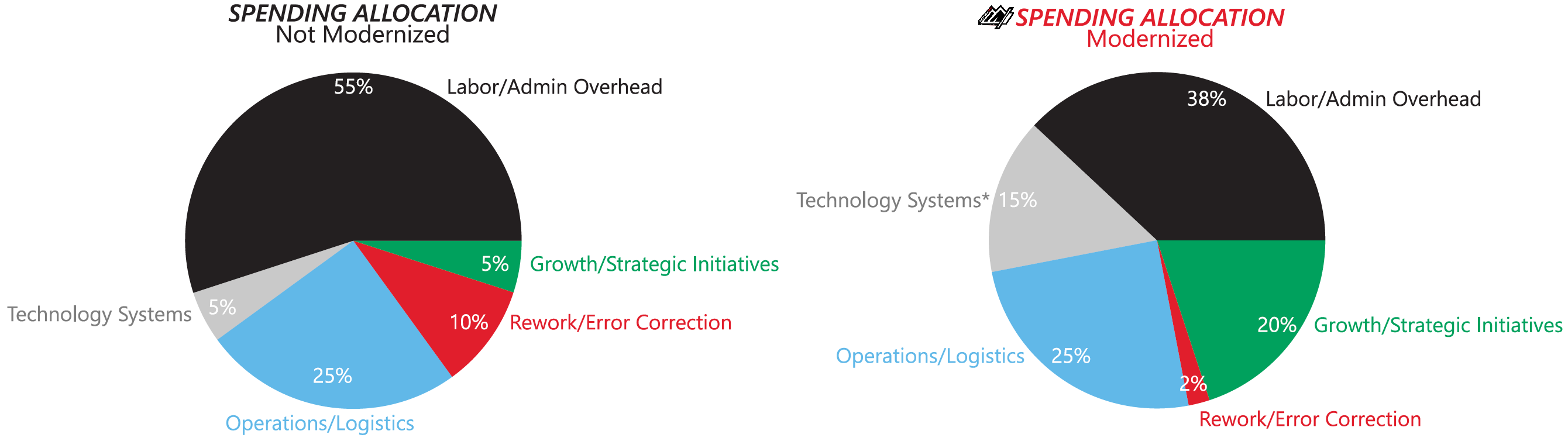
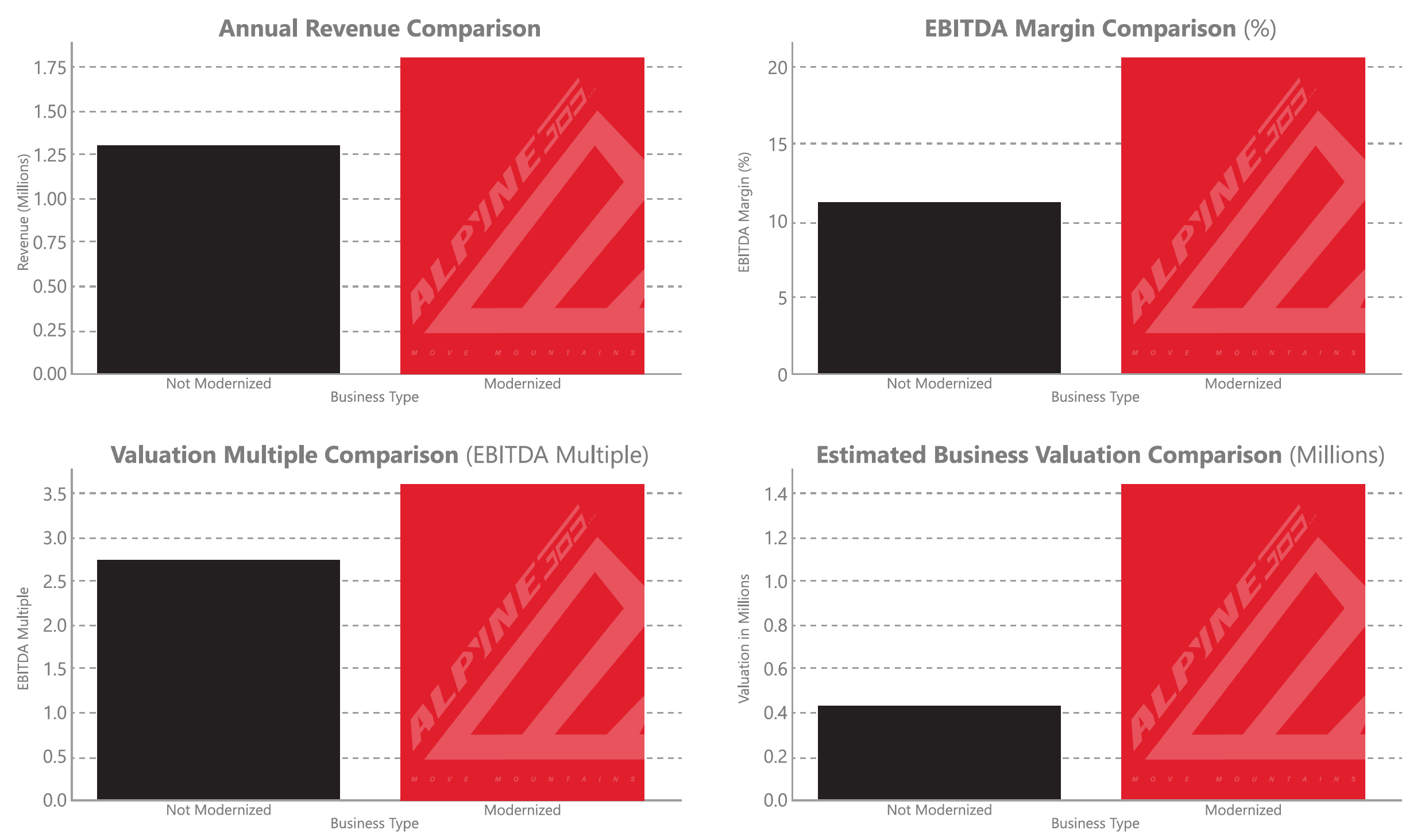
What’s interesting 👆 is that the reason your tech costs increase is because it eliminates more expensive inefficiencies while ALSO directly increasing revenue, EBITDA, and the overall valuation of the company. Remember: licensing is tax-deductible while inefficiencies aren’t.
- Heavy manual processes
- Paper, spreadsheets, duplicated work
- High time waste
- 20 to 40 percent labor reduction
- Automated workflows
- Predictable and standardized processes
- Fragmented data
- Inconsistent reporting
- Gut based decisions
- Centralized data
- Real time dashboards
- Fast and accurate decisions
- No standardized follow up
- Poor pipeline visibility
- Lead slip through cracks
- 10 to 25 percent productivity lift
- Automated reminders
- Consistent qualification steps
- Missed renewals
- Slow communication
- Higher churn
- Automated renewals
- Proactive updates
- Improved loyalty and retention
- Delayed updates
- Frequent count errors
- No forecasting
- Real time inventory
- Automated receiving
- Low inventory alerts
- Manual templates
- Inconsistent terms
- Errors in dates or quantities
- Auto generated PDFs
- Standardized language
- Digital signatures
- Higher error rates
- Weak audit trails
- Regulatory exposure
- Automated documentation
- Consistent records
- Reduced compliance risk
- Burnout from repetitive work
- Slow onboarding
- Knowledge trapped in individuals
- Clear workflows
- Faster onboarding
- Lower turnover
- Growth requires more staff
- Processes collapse under volume
- Owner becomes bottleneck
- Scale 20 to 40 percent before hiring
- Processes hold under growth
- Higher profit per employee
- Aging hardware
- Hidden maintenance costs
- Downtime risk
- Predictable cloud costs
- Automatic updates and backups
- Near zero downtime
- Risk of data loss
- Single points of failure
- Slow recovery
- Continuous backups
- Cloud reliability
- Resilient processes
- Slow and reactive
- Missing data
- Hard to track performance
- Fast and proactive
- Data driven insights
- Clear performance visibility
- Business relies heavily on owner
- Hard to sell
- Lower valuation
- Processes run independently
- Owner steps back
- Higher valuation
- Lower valuation
- EBITDA reduced by inefficiencies
- Higher operational risk
- 10 to 30 percent valuation lift
- Higher EBITDA via labor reduction
- Increased buyer confidence
- Inconsistent service
- Delayed updates
- More complaints
- Smooth communication
- Reliable service
- Stronger brand reputation
- Competitors outperform
- Hard to keep up
- Strong differentiation
- Faster execution
- More professional positioning
The point of all of this is simple
You built a business that works. Now it is time to make it easier to run.

Modernizing your systems does not erase what you have built. It supports it. It protects it. It helps you grow without burning out your team. And it lifts the long term value of the company because everything becomes cleaner, more reliable, and more predictable. If you ever want to talk through what this might look like for your own business, I am always happy to sit down and figure it out with you.
And honestly, there is a lot more behind the scenes. But this is the heart of it:
Better systems make a better business.